Friday, July 3, 2009

I just got an email from Joseph Browning.

James,

I'm pleased to say that the voting members of Your Games Now have decided that they would like to have your products sold next to theirs and your company in our cooperative venture!

So LotFP: RPG pdfs will be available at Your Games Now.


To the question of "When?" I have my next appointment with a caseworker on Wednesday to decide if I'm to get that business start-up grant. I'm certainly more well-armed with both information on the market as well as details of how I'll operate and publicize between the Noble Knight and Your Games Now deals, as well as the upcoming Roolipelaaja interview.

But after that recommendation is made, I'm told it will be a week or so before I receive a final decision, and then it's literally a matter of going to an office and registering, and then LotFP: RPG will be Open For Business and have stuff On Sale. The LotFP: RPG website is being revamped to look more professional.

And I'm rather excited right now. And nervous. I tell you, if this whole venture fails, it's not like I'm going to have any excuses. :D

Right now I'm going to have dinner, then I'm going to sign my contract and send it back to Mr. Browning, and then I'm going to ready the promotional copies of Death Frost Doom now that I know what the sales outlets are going to be. Then prepare the promo blurbs to use for DFD... and then get back to work on the unfinished projects so I can prove that I can put something out more frequently than once every eight to twelve months!

See you in Helsinki at the end of the month, Joe. :)

My Tentative Ropecon Game Schedule

Ropecon is July 31 - August 2, and I'm planning to run games on the first two days. Here is what I submitted to the organizers:

July 31st 4pm
Original D&D (1974)/Swords & Wizardry - The Spire of Iron and Crystal
4 - 10 players
4 Hours

July 31st 8pm
Advanced Dungeons and Dragons 1st Edition - Cairn of the Skeleton King
4 - 10 players
4 Hours

August 1st 12:01am
Advanced Dungeons and Dragons 1st Edition - Tomb of Horrors
4 - 10 players
Until Death, Victory, or Everyone Quits! ... or 6am

August 1st 12pm
"Basic/Expert" Dungeons and Dragons/Labyrinth Lord - Castle Amber
4 - 8 players
4 Hours

August 1st 4pm
Advanced Dungeons and Dragons 1st Edition - The Fane of the Poisoned Prophecies
4 - 6 players
4 Hours

August 1st 8pm
Advanced Dungeons and Dragons 1st Edition - Sanctum of the Stone Giant Lord
4 - 9 players
4 Hours

August 2nd 12:01am
Advanced Dungeons and Dragons 1st Edition - Slave Pits of the Undercity
4 - 9 players
Until Death, Victory, or Everyone Quits!

I'm run the Tomb before, and I ran Slave Pits way back when, but otherwise, these will all be first-time runs for me.

One thing I was thinking of doing was saving myself the rules confusion and running everything under Labyrinth Lord rules, but I'm worried because AD&D assumes a bit more powerful characters pound-for-pound so I'm worried about inviting an even worse bloodbath than some of these are going to be.

Old Geezer Brings Down the Hammer...

... he's good at that. Remind me to stay out of his reach. :D

The quote from here about this.

Okay, so Skip Williams finally admits he was one of the 13 year old kids who kept getting his character killed by Gary and Rob because he had his head up his ass.

Note the comment about "aribitrary and capricious GMs." Good GMs aren't, and neither Gary nor Rob ever were.

About 1974 there was a sudden influx of younger high school age kids into Gary's mostly-adult game. We are still seeing the aftereffects.

Also, I was Skip Williams' patrol leader in Boy Scouts too.

Thursday, July 2, 2009

The Face of Old School in Finland

Nothing is definite in publishing, and this might all be cut down to a sidebar, small column, or be left on the cutting room floor completely... but...

Today I was interviewed by Jukka Särkijärvi for Roolipelaaja magazine. The interview lasted just about two and a half hours, and I'm told the plan is for it to be a three or four page article. We discussed the Old School Renaissance, my personal history with RPGs and being in Finland, and my upcoming publishing activities (I sent him advance copies of Death Frost Doom and No Dignity in Death: The Three Brides).

He said (not unprompted, I must admit) that I could end up being the face of Old School in Finland.

If he doesn't decide to focus on my weird stories and crucify me in the article, anyway. :D

He's also asked for a picture of me to run with the article. What do you guys think... would the one at the end of this post be good? Or the year-and-a-half old pic I use as my avatar here and on the forums? Or what?

Hanging in the Balance (Abridged)

Yesterday's post was one of those that I knew was out of control, but I posted it anyway because, well, I'd spent the time writing all that stuff, what did it matter that I couldn't tie it all together coherently.

Here is the short version, including the thought inspired by a comment:

Good and Evil as Cosmic Powers are useless concepts. Don't use them.

Good vs Evil Cosmic Conflicts are bad because PCs really don't have much choice as to what to do (what, turn down the mission to save the world from Great Evil?) and failure really isn't an option if the campaign is to continue afterwards anyway. That's awful gaming right there.

Divine beings are going to be portrayed through our human perspective anyway, and even the weirdest creature or purest concept is going to be anthropomorphisized so using Gods as actors within your campaign just cheapens human-based plots by dialing up the WOW factor to 11 for no reason.

A religion doesn't have any bearing on the character or disposition of its believers or its priests. A good god (as opposed to a Really Powerful Monster) will still have evil priests and worshippers, and an evil god will still have good priests and worshippers.

In a polytheistic setting, priests and worshippers won't be "dedicated" to one god, and will instead worship all of them.

Jokes about gods made of poo are hilarious.

How this relates to clerics, paladins, druids, demons, devils, and angels... that post is to come.

Hanging in the Balance

The past couple of days I've been talking about Good and Evil, and how the supernatural extremes of the two sides might be completely indistinguishable from a mortal on the ground. So how would one differentiate between the two on a conceptual level, and how to apply that to a game if the mortals don't understand the greater cosmic forces to begin with?

How do characters relate to all this? All this conjecture and theory about the Nature of Things is interesting and all, but without actual playable advice, it's really irrelevant.

First, perhaps some definitions.

Good doesn't mean perfect. Even a Greater Power of Good is going to be imperfect in ways and rub certain people the wrong way and even cause harm on the way to being Good. But for me, a working definition of a Greater Power of Good is one that, if it had its way, everything in existence would be measurably better off. Not to say existence would be a paradise or that certain types wouldn't be perhaps even fundamentally unhappy, but everything would work and people and things would be closer to kum-ba-ya than not. Grampa might still die at some point and you'd be sad, but it would be part of a natural order and it wouldn't be because he was murdered or disease shut down his body prematurely. Maybe you couldn't ever have your favorite food anymore but the abundant sustenance would keep your belly full and your body healthy. (just a couple of human-term examples)

Evil is a damn sight more difficult to define. You can't just reverse Good's definition. "Everything in existence would be measurably worse off"? What, ultimate destruction? Isn't the universe supposed to contract at some point in the future to where existence is wiped out? What, is the universe evil? phaugh! Are we talking a great cosmic sludge of everything/nothing like the Warhammer concept of Chaos? Isn't that just rather like some transcendental philosophy on LSD, with Chaos being really the natural way of things, and it's just the process of becoming one that's rather unpleasant to us Earthly fleshy types?

But Evil generally doesn't work like that. Usually, Things That Work Evil are doing it for their own benefit. The success of Great Evil would mean a great consolidation of power, where all but a very select few are worse off. It sounds like the beginnings of a political screed, but one could say that Evil is a giant Ponzi Scheme of Weal. Malicious (or even Indifferent) Overlords stepping on Great Masses of Suffering.

Or maybe all of the above.

However, one of the failings of Dungeons and Dragons when it comes to deities and in-game religion is assigning alignments to gods and assuming their worshippers should follow suit. Anything that humans would worship is going to be anthropomorphisized. Even if the object of their worship is an oozing ball of shit (literally), worshippers will apply human motivations and emotions to it, and relate them to their own activities. "Faeces the Mighty is angry at the infidels wincing at his Magnificent Odor! Kill them!" "Faeces the Mighty is pleased that his faithful feast on Super Hot Texas Chili on the eve of seeding the fields!"

But most deities, from classical mythology anyway, are not just Great Big Powerful Beings, but are powers representing aspects of the universe. You know, the Sun God, the God of the Water, the Thunder God, that sort of thing. If the deity in question actually does regulate an aspect, and isn't just taking it as a symbol, then that has consequences on a campaign.

First off, the Great Wheel cosmology goes out the window. How many Gods of Death will we need? Sun Gods? If there is going to be a variety of Powers and a polytheistic setup in a game's cosmology, a pecking order has to be established. Maybe different cultures will have their own pantheons in your game, but at the end of the day you need to decide who is In Charge of certain things. Are all of these cultures worshipping the same Sun God under a variety of local names? Or are they all actually different entities? If so... who is In Charge of the sun and who are just the lesser hangers-on?

If there is one God of the Sun (or The Sea, or Death, or Rain, etc), then even though the deity might be of a certain alignment, their worshippers and more importantly priests will not be.

Take Tlaloc (or maybe I should link to Tlālōc). Let's say that the requirement of sacrificing children is actually a requirement of the god and not just some insanity his worshippers came up with. I'd say that was evil, wouldn't you? But only if the god was perfectly capable of delivering things within his domain to worshippers without this sacrifice.

Divine certainly doesn't need to mean omniscient or omnipotent or even effective.

What if the god wasn't even aware of the mortal realm without this sacrifice? Or hated that children had to die but was unable to deliver rain without the portal to the mortal realm being opened by the sacrifice?

Or what if the god was a finkish piece of crap that wallowed in the suffering he demanded in exchange for his gifts? You think in a universe where you don't get rain and all that comes from it (crops! drinking water!) without killing kids, that doing so would be considered evil? Even if Tlaloc was seen as a cruel, oppressive force that needed to be sated in order to deliver what is necessary to life, you don't think that kind, good men would be involved in this situation which, to them, is a natural way of being?

But this is taking real-world mythology and twisting it around for the sake of argument and variety. (Not offending any of you real-world Tlaloc-worshippers, am I?) Let's go real-world modern-day religion. Jesus Christ. I've never met anyone, atheist, Satanist, anybody, who thought that Jesus Christ was anything but a good man (the greater power he represents, and the significance of his death, are different issues for purposes of this argument). Supposedly the Christian religion is based on the teachings of Christ. Yet I'm sure nobody here need take any time to think of awful, horrible people that are ordained Christian priests. I'm sure everyone can thing of events that can't be described as anything other than atrocities committed at various times during history in the name of Christ. But at the same time, I'm sure every single one of us knows decent men and/or women of the cloth.

A religion doesn't have any bearing on the character or disposition of its believers or its priests.

Also keep in mind that the very existence of a pantheon means that people in general are not going to worship just one god, and priests will generally be priests of the pantheon more than any one entity within it. Perhaps priests will specialize (actually, they definitely would), but a priest of the God of Justice is certainly going to also worship and participate in rituals to the God of Death and the God of Disease, if even just to appease them so they don't strike. They won't blaspheme or fight other priests or gods as a matter of course.

(In such a setup, would druids really exist as a separate class than a cleric? What's the difference in a polytheistic society between worshipping the God of Thunder or a God of Nature or nature itself?)

But the key to the discussion at hand is that once you're thinking in terms of religion and how people relate to these powers, rather than just the nature of the power itself, then the power itself is almost irrelevant. How Good or Evil it is doesn't make a whit of difference on a human level, because humans are both good and evil and neither Good nor Evil.

At this point, the gods become just another rung on the hierarchical ladder, just a more flashy title than "King" or "Emperor." Deities and Demigods does indeed become just a Monster Manual for higher levels. So why use them? What value does the Cosmic and the gods and their religions have beyond local cultural significance (in which case the things about the Gods are really about the priests and kings)?

None.

One of the points of the previous posts on Good and Evil is that We Don't Get It, So Stop It! Why use these alien agents of good and evil in substantive ways if in the end it's just a monster with more hit dice and an array of innate magical powers with the same motivations and schemes that a wizard or minor baron might have?

In the real world, religion matters. Whether there is an All-Powerful Being out there at all, whether it's benevolent or not, and whether or not it gives a crap about us or not is fundamental to the nature of our universe and our understanding of it. Getting it Right and The Search For Truth are absolutely important elements of our spiritual existence.

In a game... what? "You have achieved singularity and absolutely wisdom to the nature of all things" really doesn't mean anything. "You are having a crisis of faith!" is a role-playing hook no more serious than "You seek your long-lost brother." Each is exactly as intense and lasts exactly as long as the players involved choose them to. Adventurers adventure and take risks and go out there and do things. That's what the game's about, and a character's philosophies and assigned spiritual qualities are only relevant to the point where they emerge in play through their character's actions. Kwai Chang Caine just ended up kicking people a lot, you know?

Using these outer powers as actors in your games will only cheapen the actual setting. It's one thing if you're starting out with a cosmic game and planehopping is the whole deal. Fine. But if your game has any sort of verisimilitudinous grounding that you wish to be familiar to players, going for the extradimensional pizazz will kill it dead. What, are you going to cross the Five Dimensions and combat the Void Which Contains All Pain... and come home and help that cattle farmer deal with the trolls that's thinning his herd? If you've stared at a Greater Power of the Multiverse, is a political struggle on Earth going to seem like a big deal anymore? *yawn*

Any evil you can think of can be assigned to a human. Any good you can think of can be assigned to a human. Philosophical differences need only be so deep to assign motivations and actions to NPCs and hopefully PCs. Otherwise... it's a complete waste of time. Are you writing a novel? Your little home version of the Silmarillion? Or are you going to get on playing a role-playing game?

Invent your gods and your pantheons. Give them brief personalities and domains, and dress up their priests in appropriate garb and come up with a few holidays and unique rituals if it's important for your game. Then forget about them. Really. Any plot or scenario that involves a god acting, just assign it to a priest instead and move forward. D3 becomes a lot more interesting if there is no Q1 to move on to.

Yes, this is a bit of a cop-out. But between Good and Evil is the life we actually know, and by sticking to that, as strictly or as loosely as you prefer in your games, you can prevent your campaign from jumping that last threshold of illogic and absurdity and unreality that ever gamer has that will cause him to just not take the proceedings all that seriously anymore.

And now that I've just jumped the shark in my little series, there is still more to come in the coming days. Clerics (and paladins and druids!) and what this sort of game philosophy means for divinely powered characters, and the question of demons and devils and all the little planar beasties that would make a game world duller for their absence... along with the angelic deva/solar counterparts, and how to actually use them in a manner consistent with what I've been saying.

Tuesday, June 30, 2009

Pondering the Greater Good

Yesterday I talked about how if the cruelty of man is in many ways inconceivably evil to the average person, how could we understand supernatural evil?

Today I wonder the same thing... about the forces of good.

I'm not interested in goodness in terms of calm and peaceful times. In the context of a role-playing game, such times might as well not exist. If things are calm and happy and that situation is not at all threatened, chances are your game's focus will quickly move elsewhere. Content characters make for bad adventurers.

Good under stress, now that's interesting. Good that's threatened, good that has lost the ability to deal with the world on its own terms... that's what this post is about. Anyone can go berserk when threatened and tear their enemy to teeny tiny bits when threatened, and not be blamed for it. But acting justifiably is not the same as being good in my eyes. Adversity introduces a man to himself, as the saying goes.

It's difficult to think of goodness under pressure in the real world, as life is almost never about good guys and bad guys. That's one reason why it's fun to play around in imaginary worlds where good and evil are more concrete entities. Even in games with a bit of moral complexity, figuring out the right thing to do may be difficult, but making the good choice is often pretty easy.

I've thought of an unquestionably good thing.

D-Day. The assault on Normandy Beach has to be considered a turning point of World War II, correct? And stopping the Nazis can't in any way be considered a bad thing, right? Taking up the fight against evil is a good thing to do, right? But for the soldiers on the ground, that was an absolute killing field. A slaughter. The Allied Command knew they were sending countless young men to die, ripped apart by bullet, bomb, and mine. But wasn't that the right thing for them to do in the situation they were in?

Real-world religion probably has the examples most applicable to the point of conceptualizing supernatural good. Look to the Old Testament. There is some righteous destruction (in more than one sense of the term) happening there, and things which seem inexcusably cruel to me. But certainly Jews and Christians do not think that the actions of God in the Old Testament are evil. Quite the opposite.

I would think that if the PCs in a role-playing game were to become agents of a Good power, or at least become involved in the schemes of the same, they wouldn't feel very good about the situation at all. I daresay from the perspective of mortals (who would absolutely not be informed of the Grand Plan, and probably be unable to ever comprehend it anyway), there would be no observable difference between the forces of Good and Evil.

In a multiverse where Absolute Good and Absolute Evil are in conflict, who's to say that the utter destruction of the PCs' entire plane of existence isn't just a tragic necessity, a smaller loss for infinitely greater gain elsewhere, in Good's efforts to fight Evil?

"Would you ever really want to see an angel?"

Monday, June 29, 2009

Pondering Great Evil


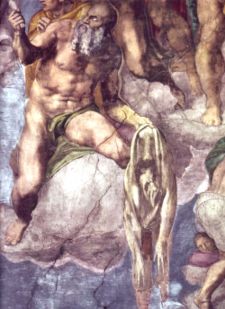
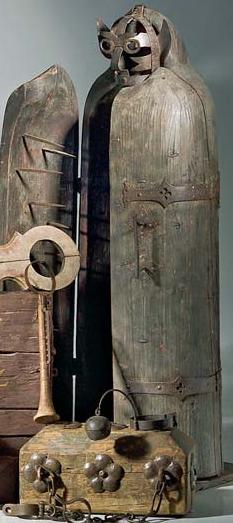
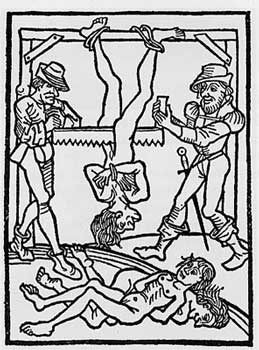
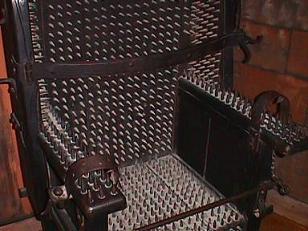
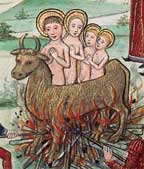
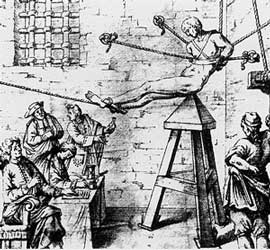
All of these are real devices/methods used by official sanction, both secular and religious, at various points in history. Men who thought they were doing what needed to be done invented, ordered, and administered these punishments. While many of the people involved were no doubt considered sick bastards even during their own time, many were just people. Could be you, could be me, if times and attitudes of enlightenment in the surrounding culture were different.

Just men. Ordinary men in primitive times.

Times that are heavily reflected in the milieus we choose to role-play in.

I could make this one of those "controversial posts" about how, in cultural context, Lawful Good characters could indeed find the use of these devices and methods justified without endangering their alignments. Paladins in particular. But I'm quite content with the idea that people we would label as "Good" within a game might indeed be "Good" as we, and not our characters, would understand the term.

What makes this interesting to me is that in ancient and medieval times, such punishments were invented by ordinary people. Even if we accept the idea that this was all the domain of only the most extraordinarily cruel and vicious and depraved examples of humanity, no matter the inspiration, it's still just a product of man.

The supernatural exists, by definition, in fantasy role-playing games. Demons and devils and millennia old dragons and twisted elves and goblins and trolls and undead spirits exist, and are all supernaturally evil in ways man can not be. (I'm now thinking Hellraiser is an inspiration; at least it's flashing heavy in my mind right now.) Their plots and aims and ideas of justice and "just" punishments - to say nothing of what the philosophies of the unspeakably cruel, by comparison, examples of their kind would be - must be far beyond human ability to comprehend.

Or, in terms of a role-playing game, imagine and present as an in-game element, narrative or otherwise.

I guess this is why I largely make the "bad guys" in my games human. Humanoids, especially the smaller ones, are easy enough to grasp (add in the National Geographic-inspired imagery of a pack of wolves running down and devouring an elk to a cannibal humanesque cruelty), but the smart creatures? The mind flayers and gith and abeloth and the rest? I wouldn't know how to accurately portray that sort of thing. To me, assigning wholly human traits to the supernatural, a la classical mythology, is rather lame and selling the entire concept of otherworldly beings far, far short.

So they show up in my games, but always incidentally, always for rather unexplained or even seemingly stupid reasons (the players might as well treat them as random).

I suppose this might be one reason I wasn't outraged by Carcosa. If anything, it seemed tame to me in that the rituals were so obviously human-borne cruelty rather than the setting-explained result of Snake-Man experimentation. It should have been far, far worse, but we as writers literally lack the words to describe sadism we can't even comprehend in the first place.

It also occurs to me that so many RPG campaigns, perhaps in an effort to make things seem more epic, skip over antagonistic human elements and base any plots or quests on direct supernatural plotting or activity, where perhaps sorcerous (or clerical...) manipulation of those elements might seem more "true," and not revealing so much of the outer worlds in such concrete, gameable, human terms as is necessary if the personalities, circumstances, and lairs of the dimensional others are to be instigators. But "Stopping the Dark Lord GGrrnnargh" is somehow more appealing and urgent and satisfying a quest than, "The wizard Apost'Rophe is going to summon and bind a demon, we must stop him!"

It's a shame that all those "outer planes" spells from AD&D don't much get used. But why would they, when early on it was established that demons walk the Earth (or Oerth, to be more accurate) just because, and the characters meeting them were supposed to be high enough level where fighting them was possible. So why deal with the mumbo-jumbo when the objects of the mumbo-jumbo were already there? In a different world Tsojcanth would have had different effects.

Evil is a tough thing to get one's mind around. And so, perhaps, are rambling posts.

(images from here)

Thursday, June 25, 2009

"Old School Renaissance" Category at Noble Knight Games

Right here. It can be found under the "Browse by Genre" menu item on the left side there.

Spread the word, will you? I talked late last year and earlier this year about us needing our own "IPR" type of central mail-order house. Noble Knight isn't exactly a small and specialized venue, but Aaron over there loves the old stuff (I found out via the Acaeum that he owns the original Otus cover artwork from Deities and Demigods!), and of course he's going to support and back an idea that gives his shop some focused attention and sales.

If you're publishing a project that fits (and to avoid dilution or confusion I do believe the things under this header will be material for 0e/"Basic"/1e and their clones), do contact Noble Knight to see if you can be carried as well.

Wednesday, June 24, 2009

Green Devil Face #3 Deadline: June 30. Less Than a Week!

Next deadline likely won't be for a couple/few months, and this will be the first fresh issue to be distributed by Noble Knight, so don't miss this one. All contributors receive a print copy of the issue their work appears in, and they retain full rights to their work.

We even have a new logo that Jeff Rients made. What do you think?